
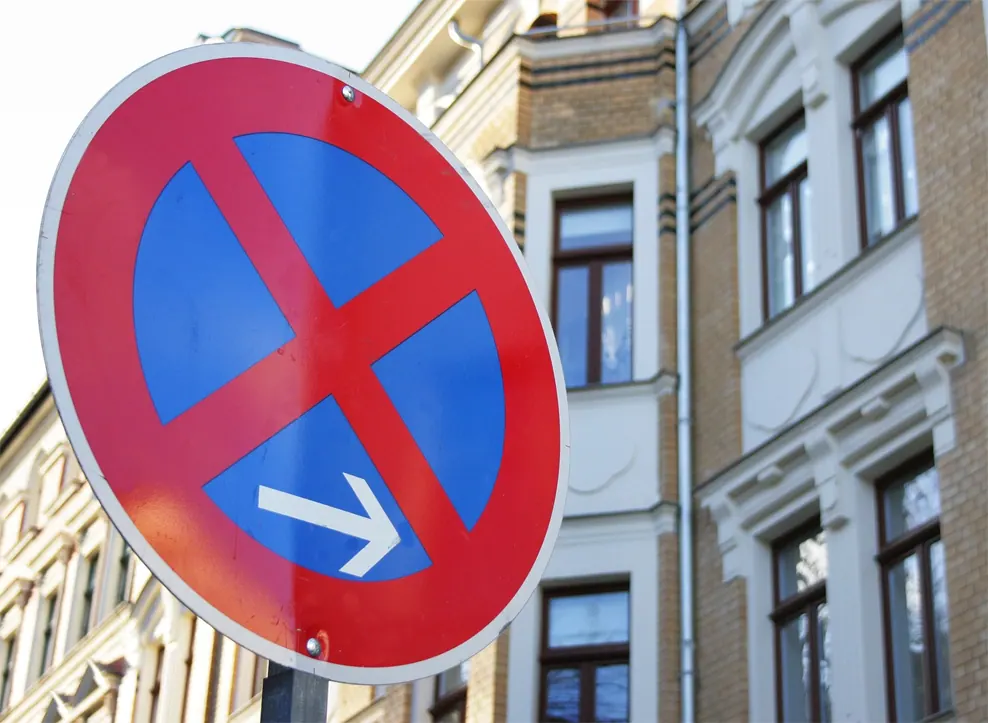
Moving house is always exciting, often nerve-racking and usually stressful. In cities, finding a parking space during the move is one of the biggest difficulties. Who wants to carry their boxes across several streets to their new home? A temporary no-parking zone (Halteverbot) in front of your old and/or new home solves this problem quickly and easily.
Your own no-parking zone – what you need to know
As a general rule, no-parking zones may only be set up with official permission. The rules differ from federal state to federal state, from city to city and sometimes even from municipality to municipality. This applies in particular to costs, processing times and responsibilities. The reason is that no-parking zones are not governed by the Road Traffic Act (Straßenverkehrsgesetz), i.e. federal law, but by state law. Implementation and the respective responsibilities are governed by Section 44 of the StVO (German Road Traffic Regulations). Your local council or citizens’ office can tell you whom to contact. A call to the road traffic office or the highways authority will also clarify matters. Throughout Germany, it is prohibited to put up home-made signs or to cordon off areas with barrier tape, wheelie bins and the like.
What does the law say about temporary no-parking zones?
Exemptions and permits are governed by Sections 44 to 47 StVO (German Road Traffic Regulations). Under Section 46 et seq., they can be granted by the road traffic authority in individual cases or generally. These include, among other things, no-stopping and no-parking restrictions as governed by Section 12 StVO. Paragraph 3 states that permits are granted subject to revocation and to corresponding ancillary provisions (conditions, time limits, requirements); paragraph 4 governs responsibilities and scope.
Applying for a temporary no-parking zone for your move
To obtain permission for a temporary no-parking zone, you must submit a written application to the responsible road traffic authority or its representative. The authorities usually provide forms; informal applications are not normally accepted. You should always apply in good time because, depending on the location, the authority, its size and its current workload, processing can take up to three weeks.
The responsible case officer will tell you how long you should expect it to take. They will also tell you whether you are allowed to put up the signs yourself or whether the highways authority has to do this for you – or whether you have a choice – and what costs to expect.
Don’t feel like dealing with the applications and visits to the authorities yourself? You can easily order no-parking signs online here.
Once all the formalities have been completed, you or the highways authority – depending on the regulations – put up a notice sign three to four days before the no-parking zone comes into force. In addition to the date and time, this shows which area will be closed off for the specified period. You or the highways authority staff must also record the vehicles currently parked in the future no-parking zone in a so-called pre-registration list, stating the vehicle make, registration number, location, date and time.