
Contents:
- Introduction
- Identity is more than the details on your ID card
- Proving your identity on your smartphone
- What this means for housing companies
- End of the blog series
In the last two articles, we looked at the benefits of digital communication with flat seekers and tenants. We also established that humanity and digitalisation are not mutually exclusive; in fact, as a result of legal and generational change, they now even depend on each other to some extent.
But how can I, as a landlord, make sure that the person at the other end of my digital process really is who they claim to be?
At the latest when it comes to sensitive processes such as opening a digital door lock for an unaccompanied viewing or digitally signing a tenancy agreement, it is important that we have not only clearly identified the other party beforehand, but also sufficiently authenticated them.
Interestingly, housing companies‘ requirements regarding the necessary evidential value differ widely here. But that is not today’s topic. Anyone interested in the differences and details of legally compliant digital signatures for tenancy agreements should take a look at this article.
The challenge I want to address in this article lies less in the particular form of identity validation and more in its reusability – which currently does not exist.
Just a few weeks ago, when activating a temporary prepaid SIM card, I once again had the pleasure of going through a video identification procedure. The user experience is roughly comparable to that of a COVID test: first you wait in a queue for a long time, and then the procedure itself is not terrible, but not exactly pleasant either. Such identification procedures are also costly, time-consuming and usually not fully digital. Most of the time they involve a media break in the process, for example because a separate app has to be used. So wouldn’t it at least be nice if I could reuse this digital piece of my identity?
Instead, these valuable fragments of our authenticated identity are treated like a disposable barbecue.
After two months, my prepaid card ended up in the bin, together with all the related elements of my authenticated identity. The groundwork for a legally compliant and, above all, reusable way of proving one’s identity online was laid several years ago with the eID function of the German identity card. However, anyone who uses the online ID currently needs not only their ID card but also the PIN, software to transmit the data and an NFC-enabled smartphone or a card reader to read the ID card. The user-friendliness of this service therefore leaves a great deal of room for improvement, especially if you want to use it for more everyday purposes than your annual tax return.
The German Federal Government has recognised this too: to make the online ID simpler, more attractive and better known, and to initiate a future-proof ecosystem for digital identities, six federal authorities pooled their expertise in the Digital Identities project in autumn 2020.
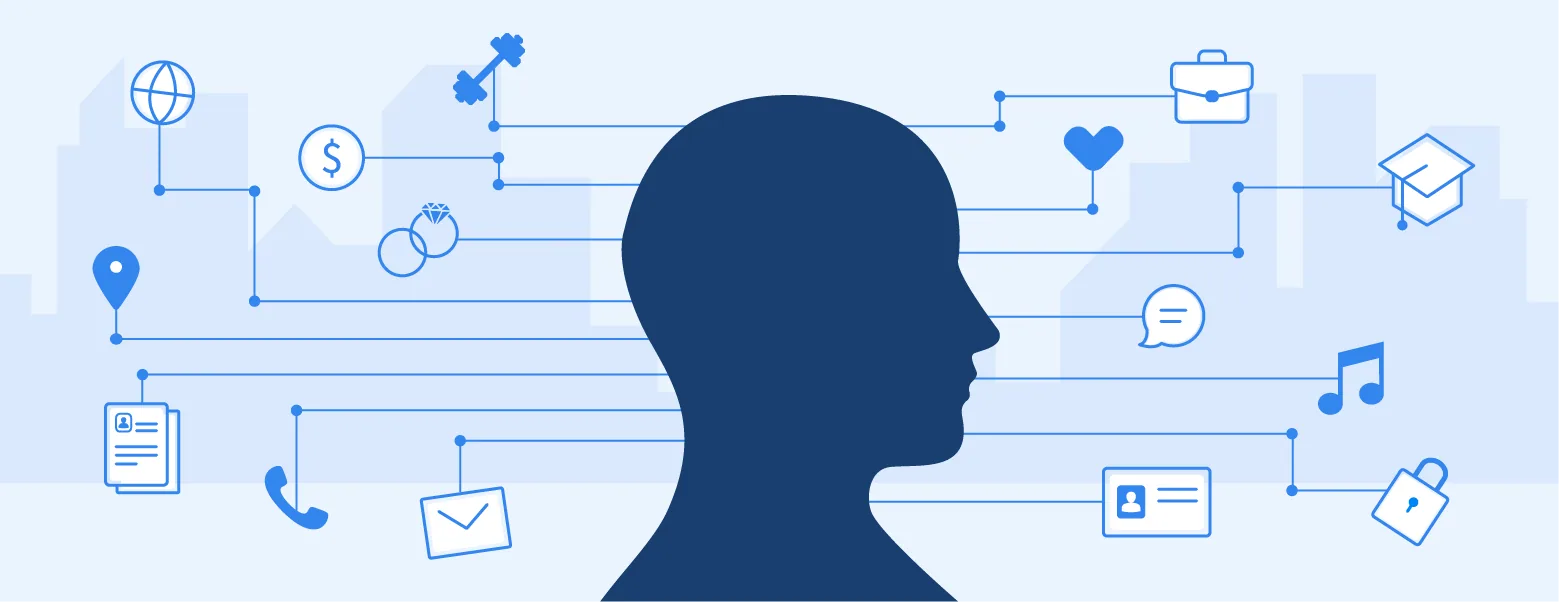
Identity has more facets than the details on an identity card. Identity consists of many different characteristics of a person.
The aim must therefore be to bring further identity attributes, such as a driving licence, student ID or similar, onto the smartphone, going beyond the function of an identity card.
At its core, this approach is about users managing their digital identity themselves, without depending on a central identity service provider that stores their personal data, for example. The best-known means of doing so is called a Self Sovereign Identity System (SSIS) and is essentially the digital equivalent of a wallet.
In the SSIS world, every person is their own identity provider: they hold their identity data themselves and – with the help of a private digital key – have full control over who they grant access to which part of their identity data. To guarantee that the data is correct, users receive digital certificates of their identity attributes from trusted bodies such as public authorities, their bank or their employer.
All the individual facets of their identity are then stored in a digital wallet on the user’s smartphone. These individual identity components are additionally linked to the digital identity of the issuer. This allows the verifying party to whom one wants to prove one’s identity to verify the authenticity of each identity component.
On 21 May 2021, the Bundestag decided, on the initiative of the Federal Government, that in future it should be possible to prove one’s identity in exactly this way using a smartphone. In an initial pilot project, business travellers can already check in digitally at more than 50 hotels. The proof of identity is stored in their own wallet app on their smartphone, as are their employer certificate and billing address. At reception, a barcode is scanned and both proofs are transmitted to the hotel system in compliance with registration law. And that completes the check-in.
Further pilot projects in the areas of e-commerce, parcel lockers, opening bank accounts, buying prepaid cards and checking driving licences in fleet management are planned and in some cases already under way. The digital vaccination certificate is also set to move into this new identity wallet.
You don’t have to think long about the relevance to a housing company’s letting processes – it is even outlined as a specific use case in the official Federal Government paper (slide 7, top left image):
The individual fragments of the digital identity required to conclude a tenancy agreement can be released to the housing company independently and step by step. The great thing about it: as a landlord, you can rely 100% on all this information being correct, because every identity attribute the prospective tenant provides to you comes from a credible source.
We are not nearly as far from this vision as many people might think. As described above, further scalable use cases with well-known partners are already planned by the end of 2021. The option of storing your vaccination certificate as part of your identity in a private wallet on your smartphone will also drive acceptance further. Last but not least, each individual’s desire to protect their privacy in a digital, connected world will inevitably lead more and more people to want to (re)gain control over their own data and thus their identity.
When it comes to letting processes, you can count on me to devote myself to this topic with great passion.
But you can already take a first intermediate step in this direction today. The days when flat seekers had to enter their data redundantly into dozens of different letting systems run by individual housing companies are long gone. Immomio’s letting solution already helps flat seekers retain sovereignty over their data. All relevant information, including their authenticated identity, can be managed centrally in one place and exclusively by the prospective tenants themselves. Which housing company receives the relevant data for the individual letting stages, and how long it stays there, is 100% in the hands of the prospective tenant.
My three-part blog series is drawing to a close. I hope you have enjoyed it as much as I have. As far as optimising letting processes is concerned, I still stand by my initial statement:
Digitalisation means change. Change means stability.
Nevertheless, there is no denying that change always involves a certain amount of uncertainty. However, ignoring Generation Z, failing to see processes through the eyes of flat seekers or dismissing digital workflows as inherently impersonal all carry certain risks.
The people who run the greatest risk on earth are those who never want to take the slightest risk.
(Bertrand Russell – British philosopher, mathematician and logician)
I would be glad to accompany you personally and with minimal risk on our shared journey of changing your letting processes. If you take your first steps into the digital letting process with Immomio, you can cancel your subscription at any time within the first 30 days – simply and without complications.