
About the author:
Stefan Jess has worked in the property industry as a specialist in letting systems for more than 20 years. As Senior Account Manager, he is the direct point of contact for prospective customers interested in the Immomio letting solution.
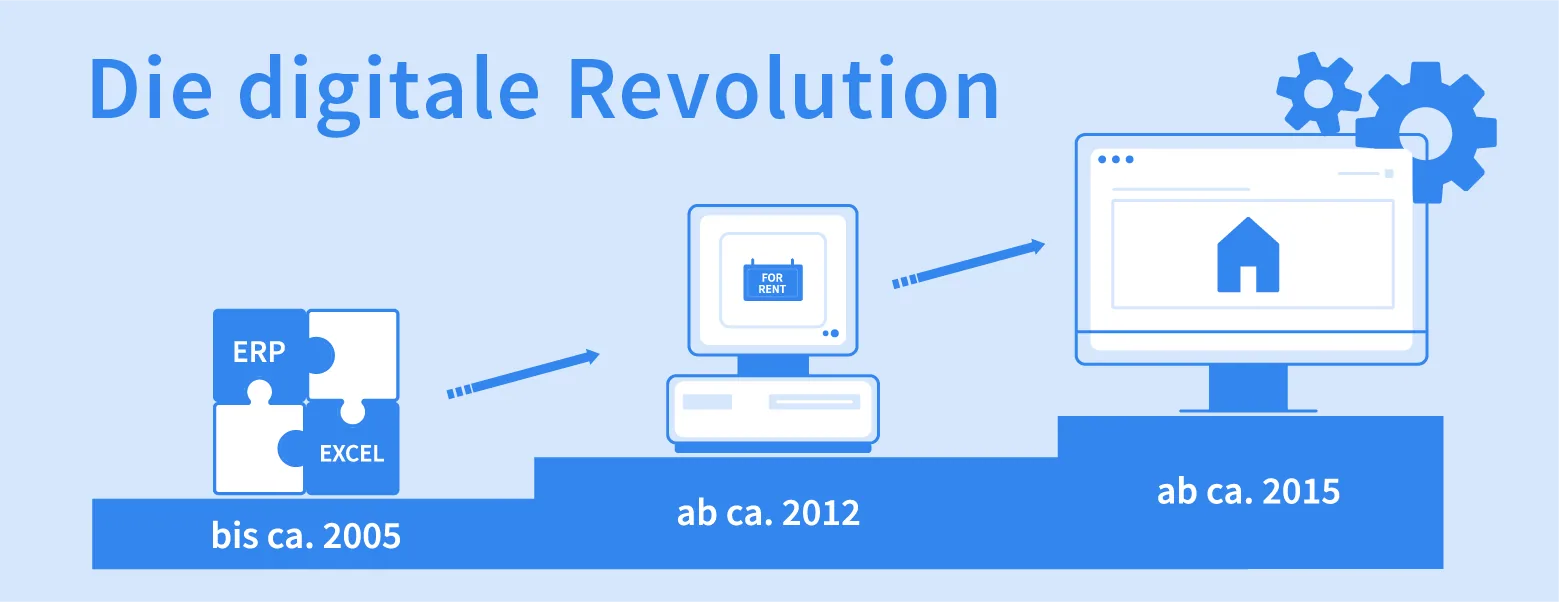
The housing industry has never been as exciting as it is today. In my view – and I have been working as an expert in letting systems in the housing industry for more than twenty years – an important threshold was crossed at a certain point. Until then, computers were little more than better administrative tools. They served, so to speak, as a powerful replacement for the typewriter and the filing cabinet, combined with a bit of computing power.
Then came the internet, and I still remember well how an ageing managing director of a municipal company said to me: “Believe me, Mr Jess, in a few years nobody will give a hoot about this internet.”
Back then, some people could not yet see what was coming for the world, and with it for the economy. Suddenly, one of the world’s largest mail-order companies found itself in direct competition with a small start-up from the USA. How did that happen? Quite simply: communication with customers had become much faster, cheaper and, above all, more flexible.
The second, even stronger push came with mobile devices. Now that almost everyone owns a smartphone and uses it diligently around the clock, the communication behaviour of consumers – and of tenants and flat seekers – has changed considerably. Flats are searched for by smartphone on the bus, damage and meter readings are reported via app, tenancy agreements are now signed digitally, and electronic locking systems are becoming a matter of course in the housing industry’s building stock.
What does the digital transformation mean for a housing company and its letting department?
Today it is more important than ever to be able to respond quickly to new developments in communication. Whether in a tenants’ or a landlords’ market. Whether in Lübeck, Duisburg, Stuttgart or Erfurt.
This becomes particularly clear when IT-based letting systems are divided into three generations
- First-generation systems recorded prospective tenants and their applications in the ERP system or in existing office solutions such as Excel. When a tenancy was terminated, these were then matched with more or less effort.
- As this approach could no longer meet the communication requirements of the housing market in the long term, the first second-generation systems followed around twenty years ago. These acted as a specialist solution alongside the ERP system, which then passed the flats on for marketing or for automatic matching with search requests. Another important feature was the ability of these systems to supply various property portals.
- For some years now, we have been seeing third-generation letting solutions. These platforms combine all the advantages of the first two generations with a consistent focus on the flat seeker. In a landlords’ market, they also make it easy and convenient for the landlord to keep track of strong demand at all times. In a tenants’ market, on the other hand, so-called workflow modules create entirely new, shorter response times to potential tenants. Prospective tenants no longer have to search on one of the classic property portals. The solution matches their search profiles with the ideal tenant profile of the vacant flat and, above a certain degree of match, automatically sends them the flat proposal. The flat is no longer advertised – it finds the best tenant without ever having appeared on a property portal.
For third-generation solutions such as Immomio, the functions mentioned above are the bare minimum. But what about the extras?
Which functions should third-generation letting solutions offer?
A modern letting solution should have the following features:
- Proven interfaces to all relevant ERP systems and property portals to enable work without media breaks.
- The solution should offer a high degree of standardisation and automation in communication.
- Comprehensive white-label functions ensure that the business relationship with the future tenant is not disrupted.
- “Mobile first” – the solution should be available on mobile devices for both landlords and flat seekers, including multilingual support.
- It should be possible to connect the solution to existing websites. In addition, it should optionally have its own homepage module that can be integrated into the company’s homepage quickly and to the customer’s individual requirements.
- Individually configurable questionnaires for prospective tenants, so that the specific letting requirements of each housing company can be addressed.
- Certain groups of prospective tenants must be distinguishable. A housing cooperative, for example, can then address its own members exclusively and offer housing in great detail and transparently within the framework of its own allocation guidelines.
- An individually configurable tenant self-disclosure form complements the application process and captures all data, which is then passed on to an ERP system, for example.
- An integrated messenger enables seamless and fast communication, even without using WhatsApp & co.
- Integrated interfaces to credit checking agencies and the option of a legally compliant digital signature.
- The greatest possible relief for the landlord with regard to the GDPR.
How does the introduction of new letting software work?
Introducing such a solution should not be a laborious tour de force. As modern systems are cloud-based, there is no need for installation on servers or for the purchase of an expensive licence. Flexible contract terms (monthly/annually), no consulting effort during introduction and initial system availability within a few days are now standard.
Does that complete the path to digitalisation?
That would contradict all the experience of recent decades. Digital and mobile systems will increasingly shape the customer relationship in future. Virtual viewings in new-build projects, flexible furnishing options as part of the letting process, or additional services related to moving or the tenancy are no longer a question of time. They are already here, and many more possibilities that cannot be foreseen today will follow.